
Why product reviews matter more than price in WooCommerce
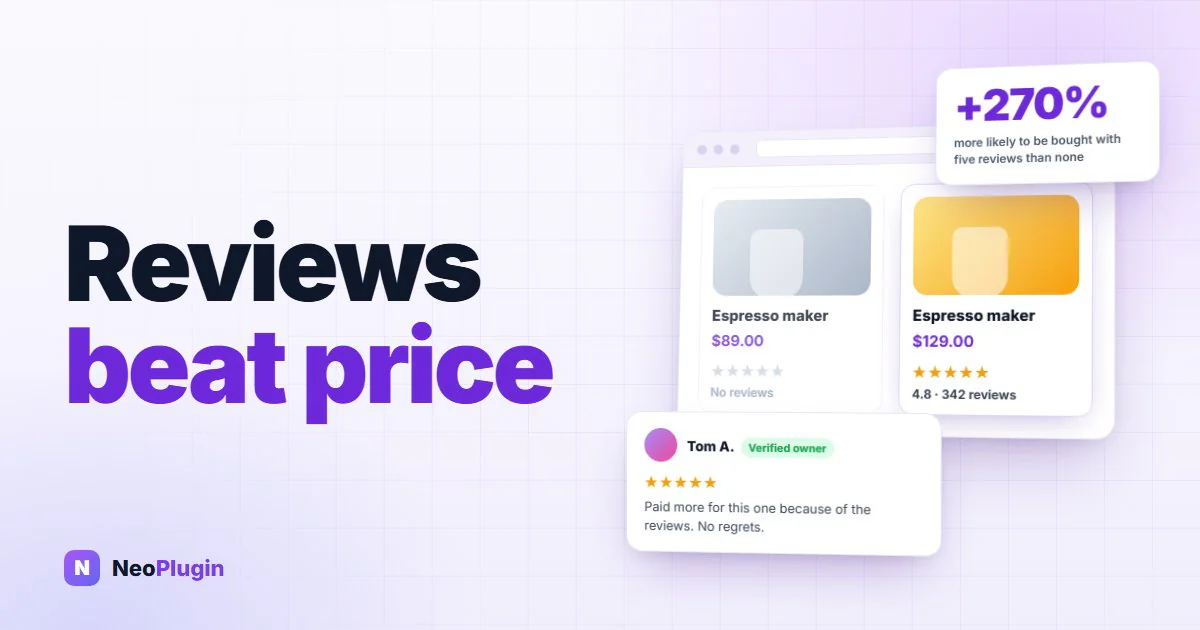
A shopper has two tabs open, comparing the same kind of coffee machine.
On the first, a competitor is selling one for $89.00. It has no reviews. On the second — yours — a similar machine is $129.00, and underneath the price sit 4.8 stars from 342 reviews, ninety-odd of them with photographs of the thing on somebody's kitchen counter.
Most people buy the $129 one. Forty dollars is the price of not having to wonder whether it is any good.
That instinct is worth understanding properly, because it changes what you should be spending your effort on. Cutting your price attacks your own margin and can be matched by a competitor tomorrow morning. A library of reviews cannot be copied at all.
The short version
- Showing reviews on a product lifted conversion by 270% compared with the same product showing none, and the lift is larger on expensive products than cheap ones.
- Most of that benefit arrives with the first five reviews. The gap you need to close is five, not five hundred.
- 99.9% of shoppers read reviews, and 79% deliberately look for stores that have them.
- A perfect 5.0 converts worse than a 4.6. Deleting bad reviews makes you look edited, not excellent.
- Reviews win the first order; they do nothing about the second. Only 27% of first-time customers ever come back on their own, which is a separate problem with a separate fix.
Reviews outrank price, and it is not close
For most of e-commerce history, price was the first thing a shopper compared. That is no longer what the research finds. PowerReviews has tracked the same questions across a decade, and reviews have moved from one factor among several to the dominant one.
| What was measured | Finding | Direction of travel |
|---|---|---|
| Most important purchase factor | Reviews now rank above price, shipping and brand | Price held the top spot in 2014 and 2018 |
| Share who read reviews at all | 99.9% | Up from 97% in 2018 |
| Share who seek out stores with reviews | 79% | Up from 63% in 2018 |
| Distrust a star rating with no written text | 52% | Stars alone stopped being enough |
| Deliberately look for the negative reviews | 96% | Up from 85% in 2018 |
The last row is the one most store owners misread, and we will come back to it.
The size of the effect was measured separately by the Spiegel Research Center at Northwestern, and the number is large enough to be worth repeating carefully: a product displaying five reviews was 270% more likely to be purchased than the same product displaying none.
Then it gets more interesting.
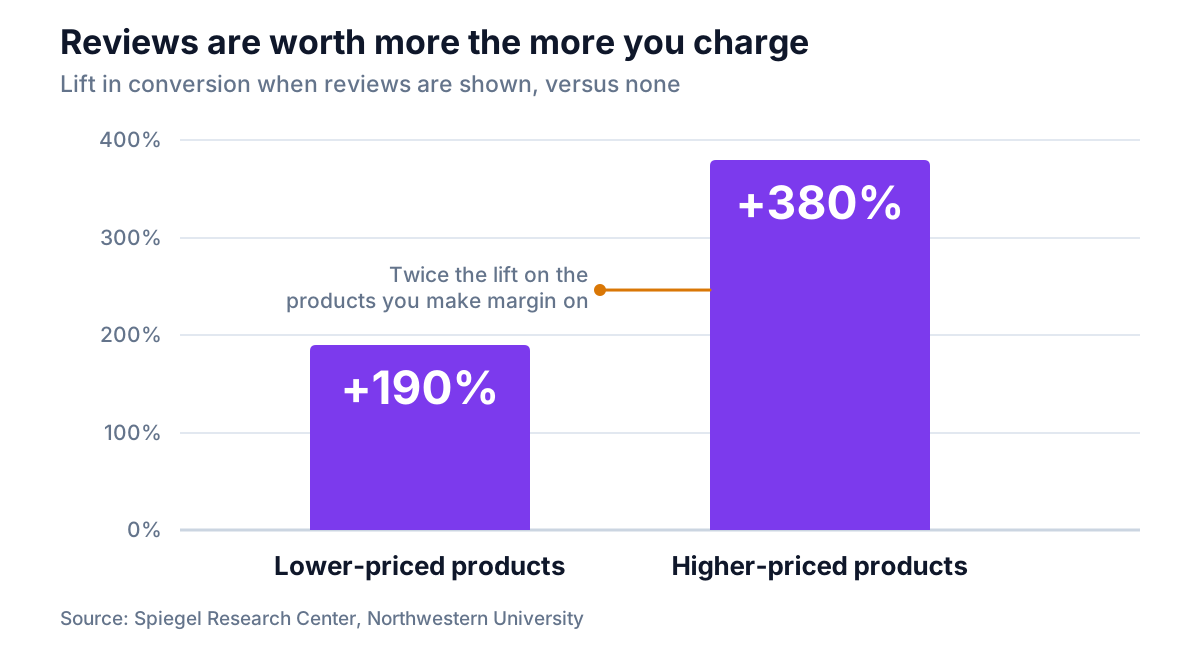
Reviews are worth more to you the more you charge. On cheaper items the lift was 190%; on expensive ones it was 380%. That is the opposite of how most people assume social proof works, and it has a direct commercial reading: reviews pay you back hardest on exactly the products where your margin lives.
Discounting attacks your margin from one side. Reviews defend it from the other.
Why shoppers trust a stranger over your own sales copy
None of this is really about stars. It is about who is speaking.
Your product description is written by someone with an obvious interest in the sale. Shoppers know this, and have spent twenty years learning to discount it. A review from a customer carries no such interest, which is why BrightLocal finds roughly half of consumers trust reviews about as much as a recommendation from someone they actually know.
A photograph goes further still. It answers the questions that cause hesitation before checkout and returns afterwards: how big is it really, is that the true color, does it look cheap in a normal room. You cannot write your way out of those doubts. Somebody else's kitchen counter settles them in one glance.
There is a second-order effect worth noticing. Competing on price attracts a customer who is loyal to the price, not to you. Competing on trust attracts one who came because other people vouched for you — a materially better customer to have won.
| Competing on price | Competing on trust | |
|---|---|---|
| What you give up | Margin, on every order, permanently | Time, once, per product |
| Who it attracts | Bargain hunters, high churn, more returns | Value seekers, likelier to come back |
| How fast rivals copy it | By tomorrow morning | They cannot |
| Where it ends | A race to the bottom | An asset that compounds |
The five things a shopper checks before believing you
Reviews are not a switch you flip. Shoppers run through a short mental checklist, in order, in a few seconds. Open one of your own product pages and follow along — the rung where you fail is the one costing you orders.
1. Are there any reviews at all?
If not, most people leave. The encouraging part is how low the bar is: Spiegel found the benefit largely arrives with the first five reviews, with diminishing returns after that. Going from zero to five is the hard part, and it is also most of the prize.
2. Are there enough?
Five gets you taken seriously. A wall of them settles the matter — 68% of shoppers want to see around 26 reviews before they feel confident. Most stores manage a burst at launch and then nothing, because asking politely only works once.
3. Are they recent?
Around 71% of shoppers weigh how recent a review is. A page whose newest review is two years old can read worse than a page with none: it suggests a shop that has gone quiet.
4. Is there anything there besides a star?
52% do not trust a rating with no words attached. Photographs are worth more again, for the reasons above.
5. Is this too good to be true?
Here is the row people misread. 96% of shoppers go hunting for the critical reviews on purpose, and Spiegel found that purchase likelihood peaks somewhere around 4.0 to 4.7 stars and then falls as a rating approaches a flawless 5.0.
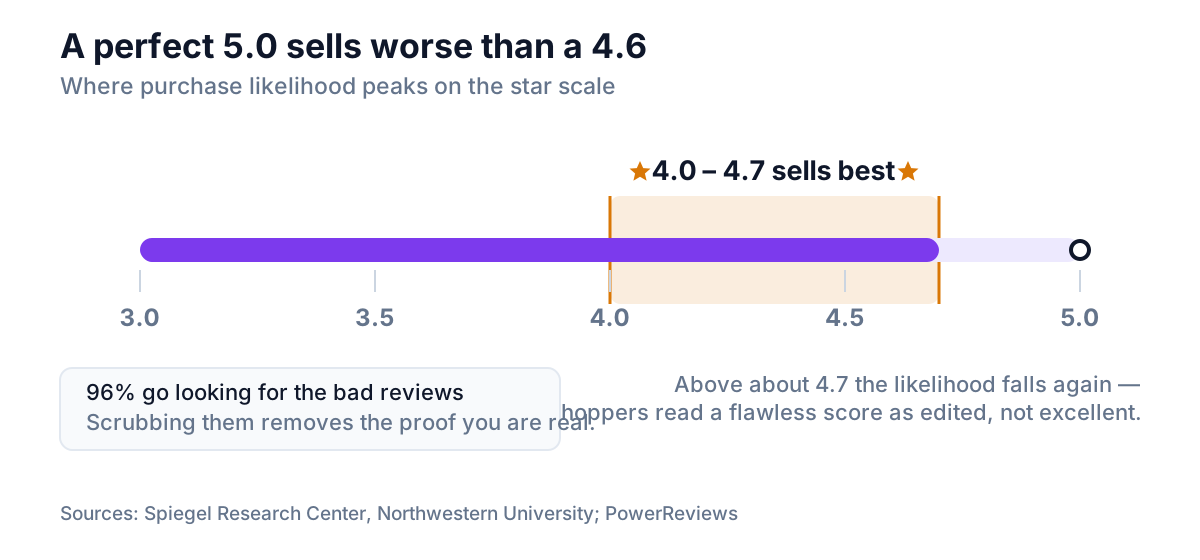
Scrubbing your bad reviews does not make you look better. It removes the evidence that you are real. A fair complaint with a polite, useful reply from you underneath does more for your credibility than another five-star entry ever will — and it is the single thing a competitor cannot fabricate.
Spam is a different problem from criticism, and it takes a different lever. If what prompted you to look at reviews today is a flood of submissions from people who never bought anything, how to disable WooCommerce reviews and comments covers which switch actually stops that — and which ones take your existing reviews, and your star snippet, down with them.
This gets stricter with younger shoppers, who grew up online and read a spotless page as a managed one.
| Signal | All shoppers | Millennials | Gen Z |
|---|---|---|---|
| Seek out stores with reviews | 79% | 85% | — |
| Go looking for 1-star reviews | 52% | 60% | — |
| Distrust a perfect 5-star rating | 46% | — | 53% |
One more finding worth acting on: marking reviewers as verified buyers improved the odds of purchase by 15%. Same reviews, same words — the badge alone did that.
What product reviews do for search, and for answer engines
WooCommerce product reviews quietly solve a problem you were probably paying someone else to solve.
You optimized the page for "ergonomic office chair". A customer wrote "this chair is brilliant for my lower back pain when I'm gaming". Now the page can be found by people searching that too, and there are far more of those searches than there are of yours. Your customers write in the language other customers use, which is never quite the language you use.
There is a second benefit. A product page normally sits untouched for months. Every new review adds fresh, unique wording to it — a signal search engines pay attention to, produced by other people, for free, as a side effect of being rewarded.
The third is the one you can see in a search result. WooCommerce writes an AggregateRating into each product page's structured data — the average score and the review count — along with the five most recent reviews, and that is what a search engine reads to decide whether to draw the yellow stars under your listing. It is written on one condition: the product has at least one rating, and ratings are switched on in WooCommerce → Settings → Products. A product with no reviews has no aggregateRating to publish, so it cannot show stars no matter how well the page is optimized. Your competitor's listing has them and yours does not, in the same result, before anybody has clicked anything. (On a block theme there is one more condition, covered in how to fix WooCommerce star ratings not showing in Google.)
That markup comes from WooCommerce itself, because the reviews are native. It is worth knowing what the alternative costs: a hosted review widget renders its stars inside a third-party script or iframe, which means another origin on every product page, a hit to your Largest Contentful Paint, and rating data that lives on somebody else's server rather than in your page's own markup.
And it increasingly matters for the answer engines that now sit in front of search. They summarise rather than list, and what they summarise about a product is largely what its buyers said about it. If your page has nothing to summarise, you are not in the answer.
Reviews win the first order. They do nothing about the second.
Everything above concerns a stranger deciding whether to buy from you once. That is half a business.
Only 27% of first-time customers ever place a second order. But the shape of that curve is the most useful thing in this article:
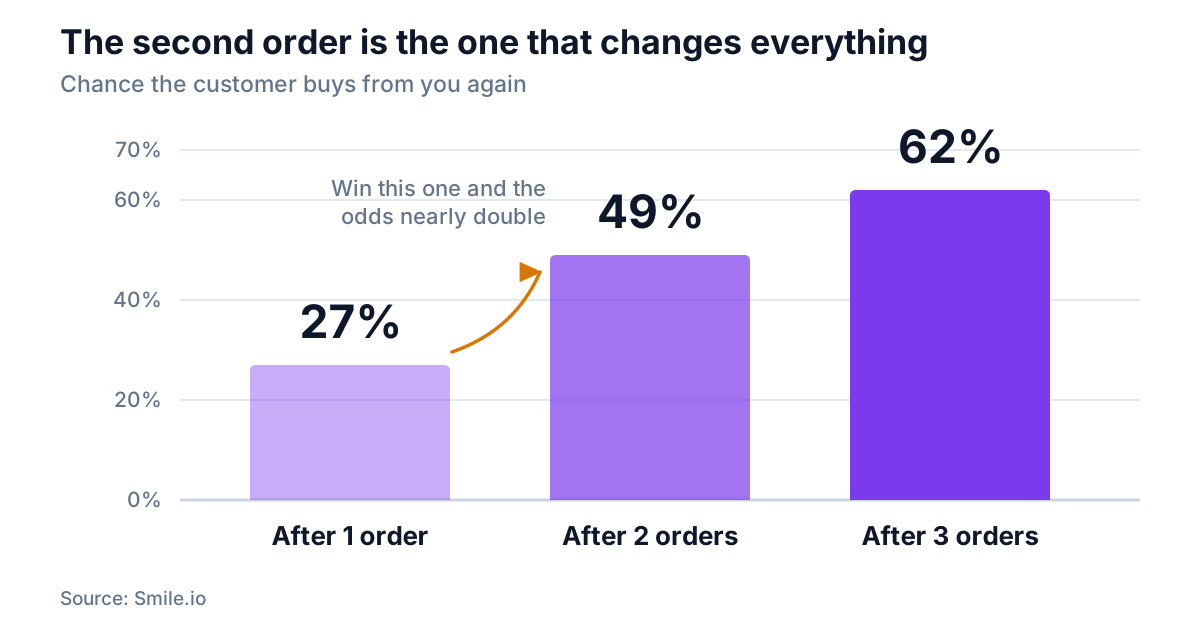
Win the second order and the odds of a third nearly double. That is why retention economics are so lopsided: Bain & Company's work, published through Harvard Business Review, put a 5% improvement in retention at 25% to 95% more profit — because you are not paying to acquire those orders again.
A loyalty program is the ordinary way to buy that second order, and McKinsey's loyalty research contains one finding most store owners get backwards. Members who redeem their points spend 25% more than members who signed up and never did. Unspent points are not a saving — McKinsey is blunt that programs leaning on unredeemed points are counting a lost opportunity as a win.
So the mistake is not being too generous. It is making the points hard to spend. If a customer has to hunt for a balance or find a code, the program is costing you the liability without buying you the behavior. There is a full walkthrough of building one — earn rates, redemption, expiry and what the whole thing costs — in how to build a WooCommerce loyalty program that gets spent.
Reviews and loyalty points are two halves of one machine
Read those two findings side by side and something falls out of them.
Reviews are what convince a stranger to place a first order. Points are what turn that stranger into the 49%. Most stores buy two separate tools for those two jobs, and the tools never speak to each other.
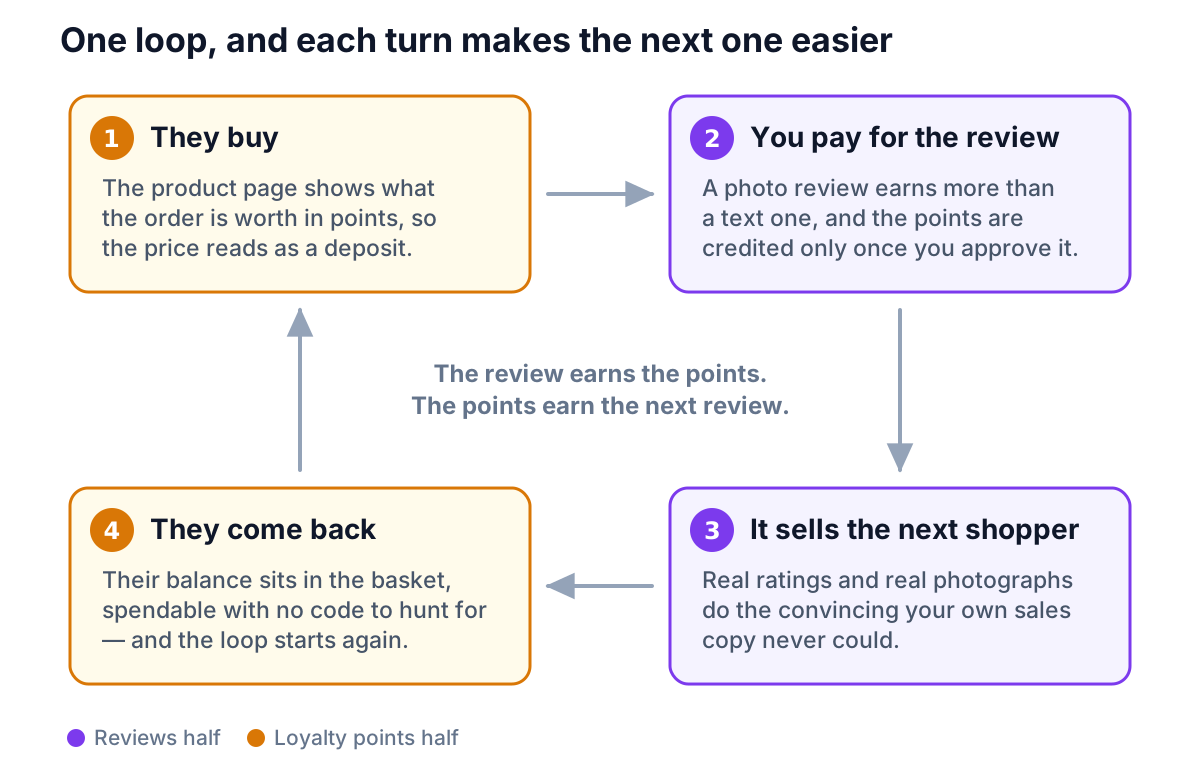
Joined up, they solve each other's hardest problem. Reviews are hard to collect because customers have no reason to bother — points are a reason. Loyalty points are hard to justify because they are a pure cost — reviews are the return. Each turn of the loop makes the next one cheaper.
That join is exactly where most setups break. A loyalty plugin cannot award points for a review it did not record, so it watches a separate review plugin and infers. Change either one and the connection quietly stops working, usually without telling you, and usually after you have already promised customers the points. NeoGrow records the WooCommerce product review and holds the points ledger itself, which is why there is no join to break — and why it is free rather than metered by review volume.
There is a quieter question worth asking of any review tool: where does the proof end up? A review collected natively is a WordPress comment on the product, and a photograph attached to it is an ordinary attachment in your media library. Both are in your own database, exportable, and visible to WooCommerce — which is why the product page can publish its own rating markup at all. Proof held in a hosted platform's silo is proof you are renting: it renders through their script, and it leaves with them.
What to actually do this week
- Pick your five worst pages. Not your best sellers — the products with zero reviews. That is where the 270% lives.
- Give people a reason to write one. Goodwill produces a trickle. A reward produces a habit.
- Pay more for a photograph. WooCommerce photo reviews are the part that answers size, color and condition, and the part a competitor cannot copy.
- Stop deleting the bad ones. Reply to them in public instead. That is the credibility rung, and it is free.
- Make redeeming trivial. If the balance is not visible in the basket, you are carrying the cost of a loyalty program without the sales it is supposed to buy.
- Leave it running. Recency is a rung too. A campaign decays; a standing reward does not.
None of this requires a bigger advertising budget. It requires that the thing your customers already think about your products becomes visible to the next person who visits.
The settings and steps behind each of these are in the complete guide to WooCommerce product reviews.
Frequently asked questions
Do product reviews really matter more than price?
For most shoppers, yes. Research from Northwestern's Spiegel Research Center found a product with five reviews was 270% more likely to be purchased than the same product with none, and PowerReviews puts the share of consumers who read reviews at 99.9%. Price still matters, but a review is the cheaper lever: a discount costs you margin on every order forever, while a review is written once and keeps working.
How many reviews does a WooCommerce product need?
Fewer than most people assume to get started, and more than most people collect to finish the job. Most of the measured conversion benefit arrives with the first five reviews on a product. Confidence keeps climbing after that: about 68% of shoppers say they want to see roughly 26 reviews before they feel sure. Treat five as the urgent gap and 26 as the target.
Do negative reviews hurt sales?
Less than a spotless page does. Purchase likelihood peaks around 4.0 to 4.7 stars and falls as a rating nears a perfect 5.0, and 96% of shoppers deliberately seek out critical reviews. A few fair complaints with helpful public replies from the store owner increase credibility, because they are the proof the reviews were not curated.
Are photo reviews better than text reviews?
Yes. Photographs answer the size, color and condition questions that text cannot, which is why they lift conversion and reduce returns at the same time. They are also the hardest form of proof for a competitor to fake, and the reason most hosted review platforms charge extra for collecting them.
How do product reviews affect WooCommerce SEO?
In four ways. They add fresh, unique text to pages that would otherwise sit unchanged for months. They make you findable for the long-tail phrases real customers use rather than the ones you optimized for. They fill in the AggregateRating that WooCommerce writes into a product page's structured data, which is what produces the star snippet in a search result — a product with no ratings has none to publish, so it cannot show stars. And they give the answer engines something to summarise about your product, in place of a list of links.
Does a loyalty program actually increase sales, or just give away margin?
It depends entirely on whether points get spent. McKinsey found that members who redeem their points spend 25% more than members who enrolled and never redeemed, and that programs relying on unspent points are booking a lost opportunity as a saving. The cost of a point only lands when a customer returns to spend it, which means it lands on an order you would not otherwise have had.
What is the fastest way to start collecting reviews on WooCommerce?
Give customers a concrete reason and make the ask automatic. Rewarding a review with loyalty points turns an occasional favor into a routine, and rewarding a photo review more heavily steers people toward the format that converts best. You do not need a separate WooCommerce reviews plugin and a separate loyalty one: NeoGrow does both from a single plugin, credits the points only once you approve the review, and is free with no cap on how many you collect.
The bit worth remembering
Your price is a number a competitor can read off your page and undercut this afternoon.
Your reputation is several hundred people who bought the thing and said so. It took a year to build, it cannot be copy-pasted, and it is the reason someone will pay you $129 for the machine down the road at $89.
Stop discounting. Start collecting.
NeoGrow is a free WooCommerce plugin that collects photo reviews and rewards them with loyalty points customers redeem at checkout — one plugin for both halves of the loop above, running on your own store with nothing metered.