
Responding to negative reviews: a WooCommerce owner's guide
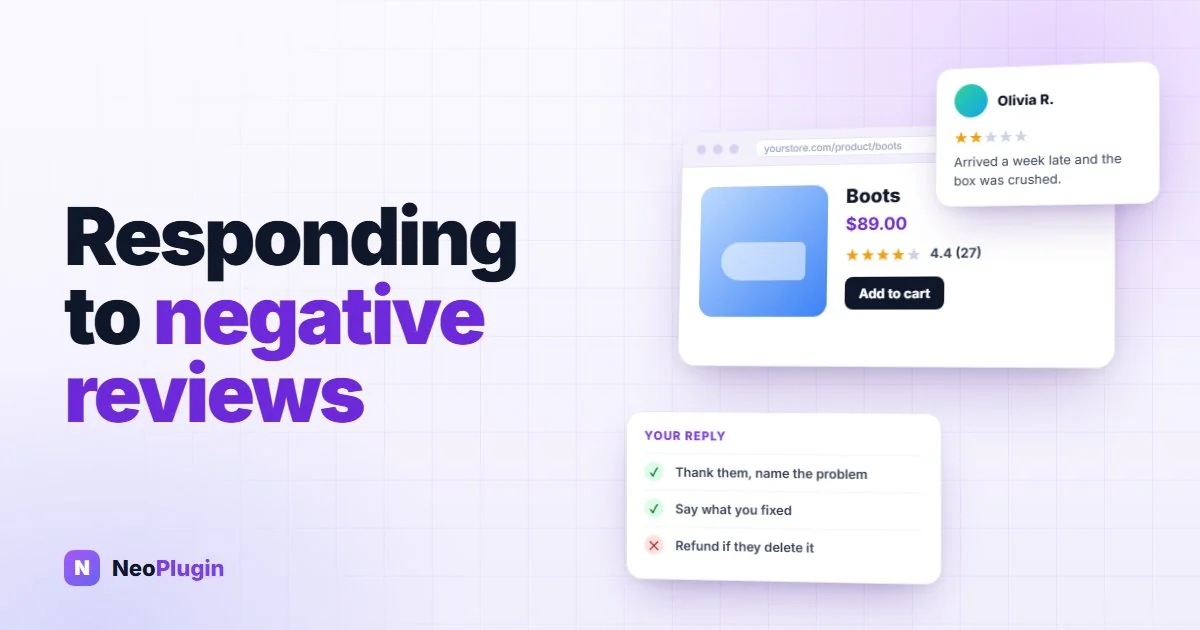
The email says a new review is waiting for approval. Two stars: "Arrived a week late and the box was crushed." The first instinct is to leave it in the queue for ever. The second is to reply and explain that the courier lost it, not you.
Both cost more than the review does. Responding to negative reviews well is one of the cheapest trust-builders a store has, because the reply isn't really written for the person who complained. It's written for the next hundred shoppers who scroll down, find the one critical review, and read what you said underneath. This guide covers why that works, how to decide what a bad review needs, how replies behave in WooCommerce (we tested them), and what to write.
Quick answer. Approve the review, then reply to it in public, once, within a day or two. Thank them, name the specific problem, own the part that was yours, say what you've done about it, and offer to sort out the rest privately. Never offer a refund or a discount in exchange for changing or removing the review, never threaten or publicly accuse the reviewer, and never remove a review because of its rating. In WooCommerce you reply from Products → Reviews; the reply carries no stars and doesn't change the product's rating, and WordPress doesn't email the customer about it, so tell them yourself.
The short version
- The reply is for the next shopper. Almost everyone reading reviews goes looking for the critical ones. What they find under them decides what they think of you.
- Sort the review first. Remove it only for what it contains, by rules you apply to every rating. Fix support problems privately before you reply in public.
- Five parts, short: thanks and the specific problem, ownership, what you did, a private route for the rest, your name.
- The lines you can't cross: no reward for changing a review, no threats or public accusations, no hiding reviews for their rating.
- WooCommerce doesn't tell the customer you replied. Send them a note yourself, or add the short snippet below that does it for you.
Why responding to negative reviews builds trust
Shoppers don't want a page of five-star reviews. As our post on why reviews matter more than price covers, almost every shopper deliberately looks for the negative reviews, and Northwestern's Spiegel Research Center found that purchase likelihood peaks between 4.0 and 4.7 stars, then falls as a rating nears a perfect 5.0. A flawless page reads as a curated one.
So the critical review is going to be read, closely. What the shopper is really checking is what happens when something goes wrong: did the store notice, did it care, did it fix it? An unanswered complaint answers that question badly. A short, specific reply answers it well, and it's the one part of the page a competitor can't copy.
There's also research on what replying does to the reviews you get next. Davide Proserpio and Georgios Zervas studied hotels that started replying to reviews on TripAdvisor, comparing them with the same hotels on Expedia, where they didn't reply. Their paper in Marketing Science (2017) found a 0.12-star increase in ratings and a 12% increase in review volume for hotels that responded. Negative reviews became fewer, but longer and more detailed: the authors suggest unhappy guests post fewer short, easily rebutted complaints once they know the business reads them. Hotels aren't stores, so don't expect the same numbers. The direction is the useful part: replying changes who writes reviews and what they write.
Before you reply: sort the review
Not every negative review needs the same thing. Before writing anything, put it in one of four piles.
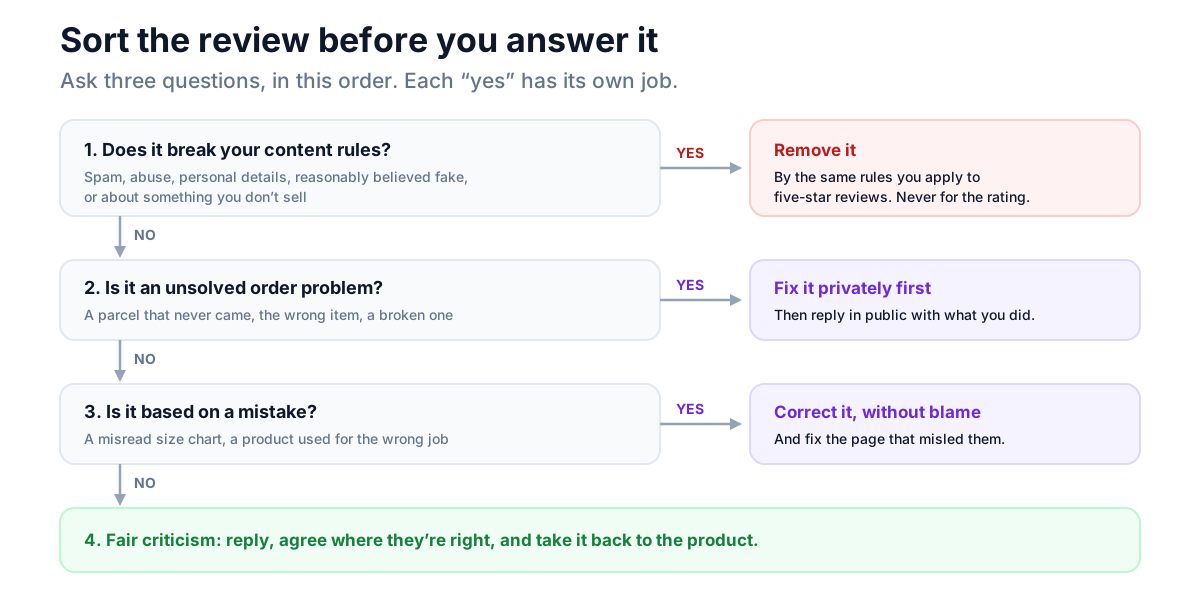
1. It breaks your content rules: remove it. Spam, abuse, a phone number or address, a review you reasonably believe is fake, a review of something you don't sell. Those are the reasons the FTC's rule on consumer reviews recognises for keeping a review off a site, and it requires the same criteria for every review, whatever its rating. "Two stars and unfair" is not on the list. Our guide to review spam covers the moderation side.
2. It's an unsolved order problem: fix it first. A parcel that never arrived or a wrong size is a support ticket that ended up on the product page. Contact the customer from the order, solve it, then approve the review and reply in public with what you did. A reply that says "we've sent a replacement" is worth far more than one that says "please contact us".
3. It's based on a mistake: correct it gently. The customer misread the size chart, or used the product for something it isn't for. Reply with the correction, as information for the next shopper, never as a verdict on the reviewer. If the mistake was easy to make, that's a product page problem too: fix the size chart.
4. It's fair criticism: reply and take it back to the product. The fabric pills, the battery dies early, the colour isn't what the photo shows. Thank them, agree where they're right, and say what you're changing. This is the reply that does the most for your credibility.
How replying works in WooCommerce
WooCommerce replies are ordinary WordPress comment replies, and that shapes what they can and can't do. We checked each of these on WooCommerce 11.1.2 and WordPress 7.1.3, with a classic theme.
Where to reply. Go to Products → Reviews, hover over the review and click Reply. If the review is still waiting for approval, the button reads Approve and Reply, and replying approves it, so read it properly first.
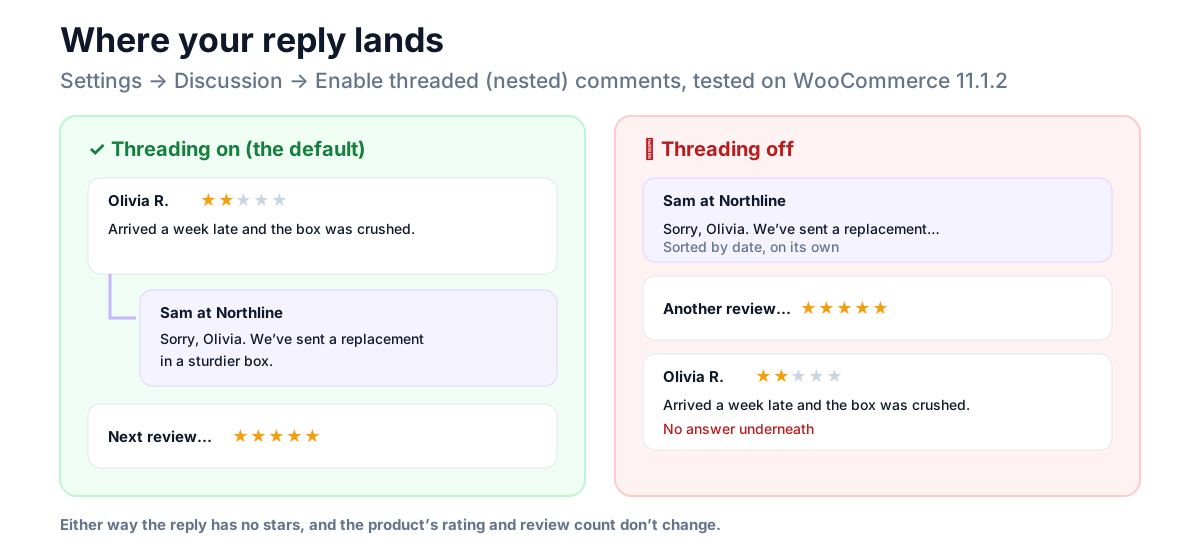
What your reply is. It's a comment, not a review. It carries no stars, and it doesn't count: we added a reply to a test product with four reviews averaging 4.75, and both figures stayed exactly the same. WooCommerce's review count only counts top-level reviews.
Where it appears. With WordPress's threaded comments switched on (the default, under Settings → Discussion → Enable threaded (nested) comments), your reply sits indented under the review it answers. We switched threading off to check, and the reply became a separate entry in the review list, sorted by date and detached from the review it answers. If your replies float away from their reviews, that setting is why.
Whose name it shows. The reply carries your account's public name, from Users → Profile → Display name publicly as. "admin" or a username reads badly under a complaint. A first name and the store ("Sam at Northline") reads like a person who'll fix things.
Who gets told. Nobody but you. WordPress emails moderators and the post author about new comments, but it never emails the person you replied to. The customer finds your reply only if they come back to the product page, so send them a short email from the order as well, or let the store do it.
This snippet emails the reviewer when someone who can moderate comments, such as you, posts an approved reply to their review. Replies from other customers don't trigger it, and neither do replies still waiting for approval. It runs on WordPress's comment_post hook, checks that the reply's author can moderate comments and that the comment being answered is a WooCommerce review, and sends the email through wp_mail(). Add it with a code-snippets plugin, a small custom plugin, or your child theme's functions.php:
add_action( 'comment_post', function ( $comment_id, $approved, $commentdata ) {
	if ( 1 !== (int) $approved || empty( $commentdata['comment_parent'] ) || ! current_user_can( 'moderate_comments' ) ) {
		return;
	}

	$review = get_comment( $commentdata['comment_parent'] );

	if ( ! $review || 'review' !== $review->comment_type || ! is_email( $review->comment_author_email ) ) {
		return;
	}

	wp_mail(
		$review->comment_author_email,
		sprintf( 'We replied to your review of %s', get_the_title( $review->comment_post_ID ) ),
		sprintf( "Hi %s,\n\nThanks for your review. We've replied to it here:\n%s\n", $review->comment_author, get_comment_link( $comment_id ) )
	);
}, 10, 3 );
We tested it on our store with outgoing mail intercepted. A reply posted as the administrator produced one email to the reviewer, with a link to the reply. A reply posted as a customer was held for moderation and sent nothing to the reviewer; the only email was WordPress's own moderation notice to the store. The Reply button on Products → Reviews saves replies through the same WordPress function, so it triggers the snippet too.
What not to touch. WooCommerce adds a Rating box to the review edit screen, so an administrator can change a customer's stars. Don't. Editing a review's rating or wording to make it kinder is the same as writing it yourself.
What to write: a five-part reply
A good reply is short, specific and signed. Five parts, in this order:
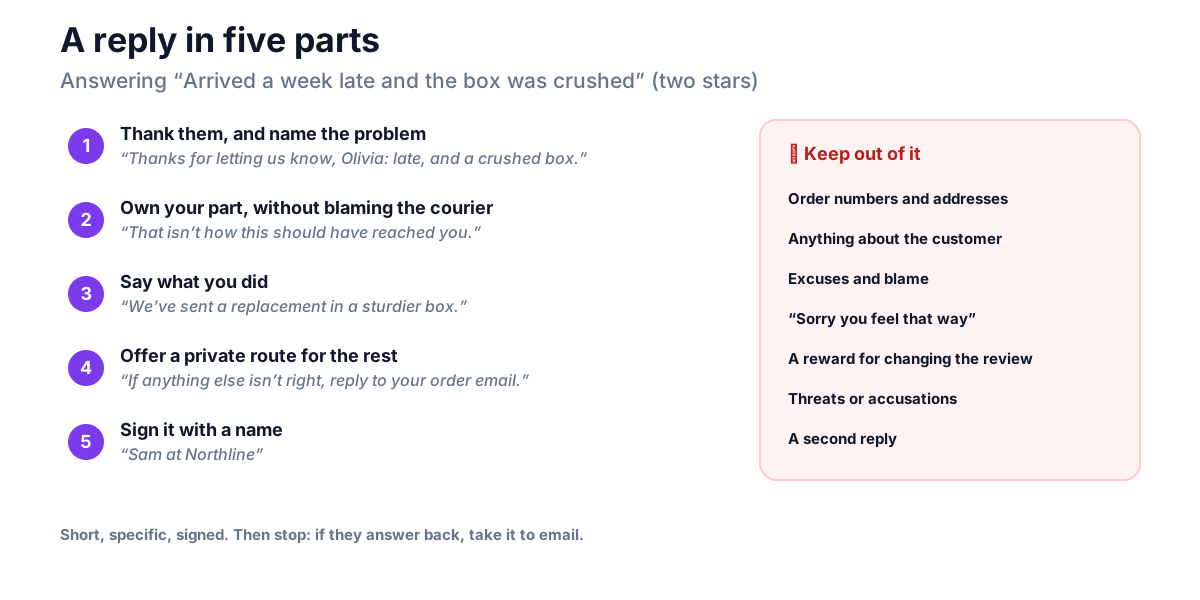
- Thank them, and name the problem. Proof you read it. "Thanks for
telling us the zip broke after two weeks" beats "thanks for your feedback".
- Own your part. Not "we're sorry you feel that way", which apologises
for their feelings rather than your product. If it's a courier problem, it's still your parcel.
- Say what you did. A replacement sent, a refund made, a supplier changed,
a size chart rewritten. Something the next shopper can believe.
- Offer a private route for the rest. "Reply to your order email and I'll
sort it." Never put an order number, an address or anything else about the customer in a public reply.
- Sign it. A first name and the store.
Then stop. One reply per review. If they answer back angrily, take it to email; a public back-and-forth reads worse than the original complaint.
Three examples
A late, damaged delivery (two stars).
Thanks for letting us know, Olivia, and sorry. A week late and a crushed box isn't how this should have reached you. We've sent a replacement in a sturdier box, and we've moved this item to a different packing method. If anything else isn't right, reply to your order email and I'll sort it. Sam at Northline
The product didn't match the description (one star).
You're right, Ryan: the photo makes the navy look brighter than it is in daylight. Thank you for saying so. We've re-shot it in natural light and added a note about the shade to the description. If you'd like to return it, reply to your order email and we'll cover the postage. Sam at Northline
A mistake the customer made (two stars).
Thanks for the review, Megan. This one runs a size small, and the size chart didn't make that clear enough, so we've added it at the top of the page. For anyone reading: if you're between sizes, go up one. If you'd like to exchange yours, reply to your order email and we'll swap it. Sam at Northline
Note what the third one doesn't say: "the customer ordered the wrong size". It corrects the information, takes a share of the blame, and turns the review into advice for the next shopper.
A template to start from
If you want a negative review response template to adapt, this is the five parts in one paragraph. Fill in every bracket with something specific; a reply that still reads like a template does more harm than none.
Thanks for letting us know, [first name], and you're right: [the specific problem, in their words]. [What was ours to own, in one sentence.] We've [what you did: replaced it, refunded it, changed the page or the supplier]. If anything else isn't right, reply to your order email and I'll sort it. [Your first name] at [store]
The lines you can't cross
Some replies aren't just bad practice. In the US, the FTC's Trade Regulation Rule on consumer reviews makes them violations. Our guide to incentivized reviews covers the rule, and the UK and EU equivalents, in detail.
- No reward for changing or removing a review. The rule forbids
compensation conditioned on a review "expressing a particular sentiment, whether positive or negative". A refund offered if they delete the review, or a voucher if they bump it to four stars, is exactly that. Fix the problem unconditionally, and leave the review alone.
- No threats and no public accusations. The rule's section on review
suppression also bans unfounded legal threats, intimidation and public false accusations used to stop or remove a review. If you believe a review is fake, deal with it through your content rules, not by calling the reviewer a liar in public.
- No hiding reviews for their rating. Showing your reviews as if they were
all or most of the reviews you received, when negative ones have been held back for being negative, is a violation. Remove reviews only for what they contain, and by the same rules for every rating.
- No steering the unhappy ones away. This one comes from the FTC's
Endorsement Guides rather than the review rule. Asking only the customers you expect to be pleased, or sending unhappy ones to a private form instead of the review form, is review gating. Our incentivized reviews guide covers why regulators treat it as deceptive.
And if the customer is happy after you've fixed things? Don't ask them to change the review. If they offer to update it, WooCommerce gives customers no way to edit a review themselves, so they'll send you the new wording. Make exactly the change they ask for, and keep their email.
Frequently asked questions
Should I respond to every negative review?
Yes, to every one you keep. The critical reviews are the ones shoppers seek out, so each one is a chance to show how the store behaves when something goes wrong. Positive reviews benefit from a short thank-you too, but the negative ones matter most.
How quickly should I reply to a negative review?
Within a day or two, and after you've fixed what can be fixed. A fast reply that only says "please contact us" is weaker than a reply a day later that says what you did. If the fix takes longer, reply to say what's under way.
Can I delete negative reviews?
Only for what they contain, never for their rating. Spam, abuse, personal information, fake reviews and reviews of something you don't sell can be removed, by the same rules you apply to positive ones. Removing reviews because they're negative, and showing the rest as if they were all of them, breaks the FTC rule and costs you the credibility the reviews were for.
Can I offer a refund if the customer removes their review?
No. Making a refund, discount or gift depend on a review changing or disappearing is compensation tied to the review's sentiment, which the FTC rule forbids. Refund them because the product failed, with no conditions.
Does my reply change the product's star rating?
No. In WooCommerce a reply is a comment without a rating, and the review count only counts top-level reviews. We added a reply to a product with four reviews averaging 4.75, and both figures were unchanged.
Will the customer be notified when I reply?
Not by WordPress. It notifies moderators and the post author about new comments, never the person being replied to. Email the customer yourself, from the order, or add the short snippet in this guide, which emails the reviewer when you post an approved reply.
A two-star review with a good answer
The goal isn't a page without complaints. It's a page where every complaint has a calm, specific answer from a named person underneath it. That page tells the next shopper more about your store than another five-star review could, and it costs you ten minutes. Approve the review, fix what you can, reply once, and let the next customer read both.